
I’m tired of posts predicting the day AI subsidies end and everyone using these tools gets a painful lesson in economics.
The story is familiar. Investors pay for our cheap subscriptions. We build our work around them. Then the money runs out, prices go up, and we regret getting comfortable.
Enjoy it while it lasts.
I don’t know the margins on every OpenAI or Anthropic plan. But even if a subscription loses money today, that doesn’t tell us what the same useful capability will cost a year from now.
That’s the part missing from the prediction.
API prices aren’t server bills
Take someone’s subscription usage. Multiply it by API prices. Compare the result with their monthly payment.
You’ve calculated what that person would pay under a different pricing model. You haven’t calculated what it costs the provider to serve them.
The price of a token is not the cost of generating it.
You also need to know how people use the plan. Someone running agents all day tells you very little about the average paying customer.
These are separate questions:
- Serving a request: does the revenue cover the cost of answering it?
- Running a subscription: does the monthly fee cover the actual usage of its customers?
- Running the company: does total revenue cover research, staff, sales, and everything else?
A company can make money on API traffic, lose money on its heaviest subscription users, and still lose money overall. There is no contradiction there.
Anthropic CEO Dario Amodei makes a further distinction: a model can earn back its training cost while the company loses money developing its successor. He explained this on Cheeky Pint in August 2025, treating each model as a separate investment.
In his February 2026 interview with Dwarkesh Patel, he gave an illustrative example:
| One model’s economics | Amount |
|---|---|
| Revenue | $4 billion |
| Cost of serving it | −$1 billion |
| Its original training cost | −$1 billion |
| Left after those two costs | $2 billion |
Meanwhile, the company spends $10 billion training the next model. The first model has paid back its training cost, but its returns don’t cover that much larger investment.
Amodei sums it up:
“Each model makes money, but the company loses money.”
These are his simplified numbers, not Anthropic’s accounts. They illustrate how model-level returns and company losses can coexist. They don’t prove that every Claude model or subscription is profitable.
A model paying for itself is different from a company funding its next model.
We can see a related distinction in MiniMax’s unaudited results for the first half of 2026. It reported $20.8 million in gross profit on $116.6 million in revenue, alongside $296.9 million in R&D spending and a $358 million net loss.
Those are company figures, not a model’s lifetime returns. But they show positive gross profit alongside a large overall loss.
Research still has to be paid for. A lab competing to release stronger models needs to fund experiments, failed attempts, and its research team. The final successful training run is only part of that bill.
That gives us two things to check: whether existing models recover their costs, and whether the company can afford the next generation. The company’s total loss alone doesn’t tell me how much, if anything, it subsidizes my subscription.
My subscription isn’t the whole business
Consumer plans are one way to sell AI. Usage-based APIs are another.
With API billing, more paid usage brings more revenue. If that revenue exceeds the cost of serving it, the difference can help fund shared research and product development. The whole research budget doesn’t have to come from monthly consumer plans.
That doesn’t mean enterprise customers already cover every lab’s costs. Nor does it mean they all pay the public list price. Anthropic offers negotiated volume discounts, for example. The word enterprise on an invoice isn’t proof of profit.
The financing problem is real. TNW, reporting on Financial Times findings, says OpenAI projects $278 billion in cumulative negative free cash flow over 2026–2030. That’s an enormous funding need.
But a cash-flow forecast doesn’t tell us the future price of an AI task. Revenue can grow through more customers and more usage while the price of each task falls.
Higher subscription prices and tighter limits are possible. Those figures alone don’t establish either as inevitable.
Yesterday’s flagship gets cheaper
GPT-4o was an OpenAI flagship. Compare its original pricing with GPT-4 Turbo and a later, cheaper model from the same provider.
These are standard API prices per million tokens, recorded from OpenAI’s pricing page on September 24, 2026. They exclude caching and batch discounts. The Luna prices apply to requests with up to 272,000 input tokens.
| Model | Input | Output |
|---|---|---|
| GPT-4 Turbo, April 2024 version | $10.00 | $30.00 |
| GPT-4o, May 2024 version | $5.00 | $15.00 |
| GPT-6 Luna | $0.10 | $0.50 |
Against the original GPT-4o, GPT-6 Luna’s input tokens cost 50 times less. Output tokens cost 30 times less. Compared with GPT-5.6 Luna, the new rates are 50% lower for input and about 58% lower for output.
We can compare one part of their capability too. GPQA Diamond tests difficult questions in biology, chemistry, and physics. The independent GPQA.ai project reports these results on the original 198-question benchmark:
| Model | GPQA Diamond accuracy |
|---|---|
| GPT-4o, May 2024 version | 48.9% |
| GPT-6 Luna, maximum reasoning | 90.9% |
The GPT-4o result comes from older Epoch AI evaluations, averaged over 16 attempts per question. Luna’s result comes from the project’s own run, with one attempt per question. These are published results from different runs, not a controlled rerun with equal computing budgets.
Still, the newer budget model answers far more of these science questions correctly while charging much less per token. That is a more useful comparison than price alone.
It doesn’t make Luna “twice as intelligent.” Nor does it mean every task costs 30 or 50 times less. Maximum reasoning uses extra tokens, and this benchmark doesn’t measure every kind of useful work.
A cheap answer that doesn’t solve the problem isn’t a saving.
What does the same result cost?
Epoch AI studies a more useful comparison in “The plunging price of thought”, published on September 22, 2026.
Its summary on X puts it this way:
“At a given level of performance, cost has fallen ~47%/quarter since 2023.”
Luke Emberson and David Roodman estimate the cheapest available way to reach a given benchmark score, accounting for token use and reasoning budgets. Their main estimate covers five benchmarks in mathematics, science, and games.
That gets much closer to what I care about: how much do I pay to get the work done?
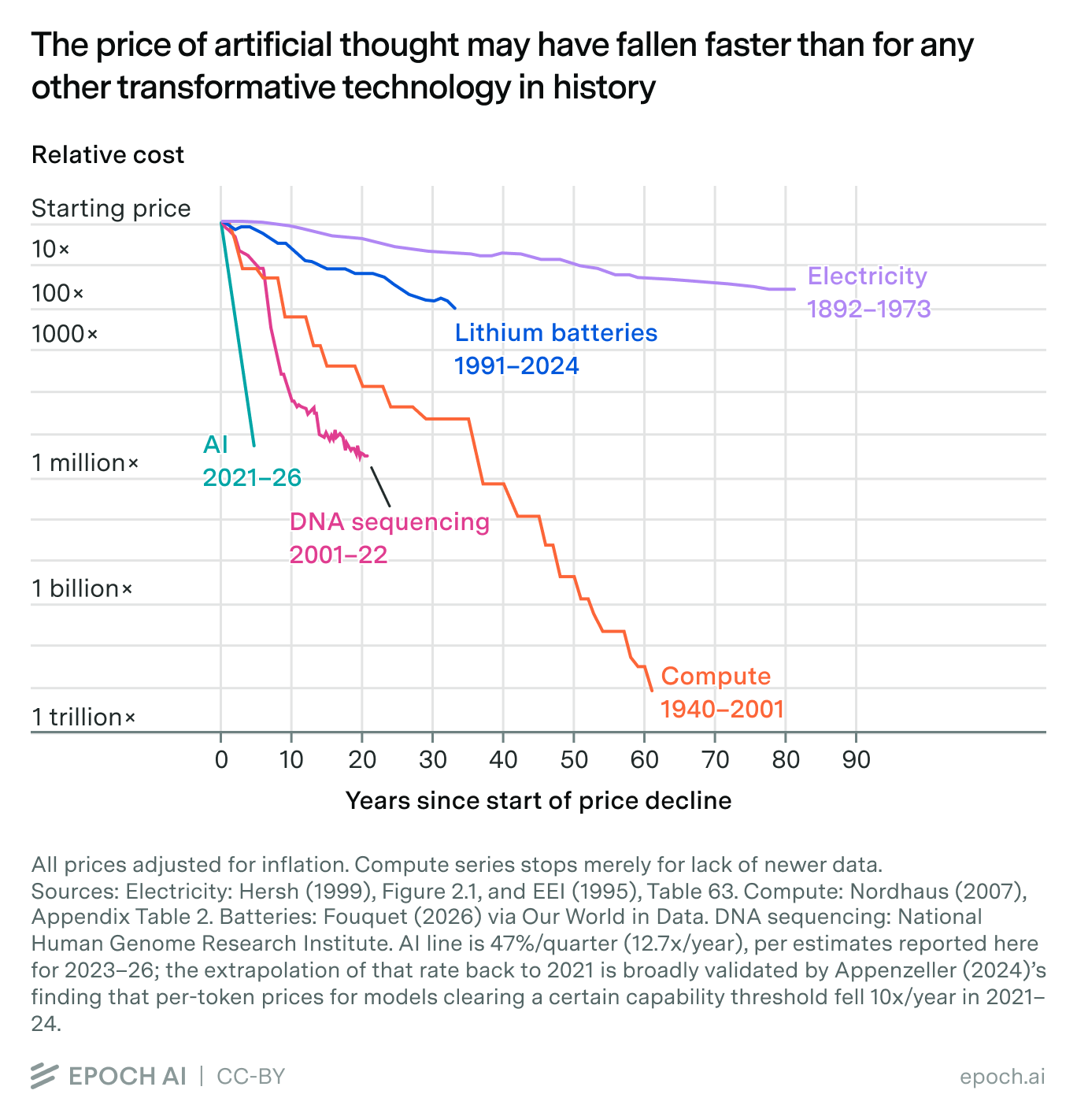
Chart: Luke Emberson and David Roodman, Epoch AI, “The plunging price of thought,” September 22, 2026. Original figure, unchanged. CC BY 4.0.
The important part is that the required score stays fixed. A cheaper model only counts if it reaches that score.
Benchmarks aren’t the whole of useful work. The analysis assumes the cheapest qualifying option is chosen, and some reasoning-budget results are estimated. I wouldn’t read it as a promise that my bill will fall by exactly 47% every quarter.
It also measures customer prices. It doesn’t reveal server costs or prove that the providers are profitable.
Sam Altman used the same per-task framing when announcing GPT-6 Sol and Luna on September 22:
“Especially compared by per-task pricing, which is the metric that should matter, I don’t think there is anything competitive anywhere in the market.”
The lower token rates are in OpenAI’s price table above. His claims about larger savings per task and beating competitors need separate evidence. I don’t need to accept that ranking to agree with the measure.
Count the cost of completing the task, including reasoning and retries.
A skeptic can still say these lower prices are subsidized. Fair. Price history alone can’t settle that. We also need reasons to expect the underlying work to get cheaper.
Engineers keep reducing the work
Serving a model costs money because it needs computation, memory, and hardware time. Engineers can improve all three.
DeepSeek-V3’s technical report describes two useful examples:
- Less computation per token. The model has 671 billion parameters, but activates 37 billion for each token. Its mixture-of-experts design uses selected parts of the model rather than all of them on every step.
- Less memory pressure. Multi-head Latent Attention reduces the information stored in the attention cache. That helps reduce the memory needed while generating text.
The inactive parameters still need storage. Moving data between chips also costs time and money. You can’t divide 671 by 37 and call the result the saving.
Serving software matters too. Grouping requests and spreading them across GPUs can get more answers out of the same infrastructure. A busy server has different economics from one sitting idle, although users still need acceptable response times.
Hardware improves as well. NVIDIA reports up to 35 times lower token costs for Blackwell Ultra than Hopper in particular agent workloads that require low latency.
That’s a vendor result under specific hardware, software, and workload conditions. It isn’t a market-wide saving. Nor should we multiply it by the architecture numbers above.
These are concrete ways to reduce the cost of serving models. They support expecting further improvements. They don’t tell us whether those improvements will cover every current subsidy, or how much providers will pass on to customers.
Open models give us other suppliers
A company hosting an existing open model doesn’t have to repeat the research that created it.
It gets the weights: the learned parameters. If the license allows commercial hosting, it can run the model and charge for access.
Someone paid for the training. Future models will need funding too. But an independent host doesn’t have to recover another company’s past research bill in every response it sells.
That creates another route to affordable access to capabilities we already have.
Hosting still costs money. Hardware, memory, maintenance, and unused capacity don’t disappear. Running your own quiet server can cost more than using a shared API. A cheap hosting price also doesn’t prove the host is profitable.
The useful difference is that access doesn’t have to depend on one company’s subscription policy.
And this isn’t only about Chinese models. Mistral released the Mistral 3 family under Apache 2.0, including small models and Large 3. That doesn’t make every open model a replacement for every closed one. It gives us more suppliers and more options.
Even a hypothetical US or European ban on Chinese-origin models wouldn’t remove all of those options. It could reduce competition and force worse tradeoffs. If it covered the weights themselves, moving the server to Europe wouldn’t solve it.
That’s a reason to take restrictions seriously. It isn’t a reason to treat all affordable AI as dependent on one Chinese lab.
I don’t need every task to use the newest model
I work with multiple LLMs every day. I use them for coding and problem solving, and I build LLM features for clients.
What counts as good enough depends on the client’s requirements. Reliability, speed, cost, and other constraints need to be clear before building the solution. There are always tradeoffs.
Once a model meets those requirements, another few points on a leaderboard may matter less than a faster answer or a lower bill.
The same useful quality, delivered faster and cheaper, is progress too.
There are two different prices here: the price of using the newest frontier model, and the price of getting work done that today’s models can already handle.
I expect the second to keep falling. The cheaper option may be a replacement model rather than the same model served forever. Competition between labs and open-model providers gives me a reason to expect at least some savings to reach customers.
That’s an expectation, not a guarantee about the next five years of pricing.
Cheaper tasks can also make more uses worth paying for. We may run more jobs, build more features, or let agents work longer. A lower cost per task can therefore sit alongside a larger total bill.
My subscription may get more expensive. Its limits may change. The newest model may cost more than I want to pay.
Those are sensible risks to consider when building around a provider. They don’t establish that useful AI must become unaffordable.
For that prediction, we need an argument about future costs, available alternatives, and competition. Today’s company loss doesn’t answer those questions.
“Wait until the subsidies end” isn’t enough of an economics lesson.